
I spent $14,000 on AI automation tools last year before I realized we were just paying for expensive ways to make mistakes faster. Most agency owners are currently chasing a ghost. They buy a dozen SaaS subscriptions, slap some prompts into a Slack bot, and wonder why their profit margins are still hovering at 20%. The problem is not the AI. The problem is your unit economics.
If you are still billing hourly while using AI to cut your production time by 80%, you are effectively penalizing your own efficiency. You are trading a $150 hourly rate for a $0.03 API call and pocketing none of the difference. To scale an agency in this environment, you have to stop thinking about tools and start thinking about agentic architectures that own the entire funnel from data ingestion to client delivery.
The short answer
Scale does not come from using AI to write faster. It comes from using AI to eliminate the need for human coordination. For an agency to scale, you must move from generic tool integration to custom agentic architectures. This means building internal assets that use your proprietary performance data to optimize client outcomes autonomously. You should prioritize tools like OpenRouter for model flexibility and Cursor for rapid development of internal tools. This approach shifts your agency from a service provider to a high-margin productized engine.
How they differ
Most agencies fall into the trap of using 'Wrappers' or 'Point Solutions'. These are tools that solve one specific problem, like generating an ad copy headline. The problem is that these tools often have a high CAC for the agency and provide zero long-term retention. They do not talk to each other. Your data stays siloed.
To scale, you need to look at three distinct approaches to AI workflows:
-
The Modular API Stack: This involves connecting specific models like the Anthropic API to your own databases. You control the prompt, the context window, and the cost. By using a gateway like OpenRouter, you can swap models based on task complexity. Use Claude 3.5 Sonnet for creative heavy lifting and GPT-4o-mini for cheap, high-volume summarization. This keeps your token usage under control.
-
The Agentic Architecture: This is the next level. Instead of a human triggering a prompt, you build a system where agents perform sub-tasks. One agent researches the client's competitors. A second agent drafts a PRD. A third agent performs a technical audit. This mirrors the human-in-the-loop protocol we detailed in our AI for product discovery teardown.
-
The Full-Stack Internal Tool: Instead of paying $50/user/month for a generic AI project manager, you use Cursor or Bolt to build a custom dashboard that fits your specific workflow. This turns your agency's 'way of doing things' into a proprietary software asset.
Head-to-head table
| Feature | Generic SaaS Wrappers | Modular API Stack | Custom Agentic Architecture |
|---|---|---|---|
| Cost Control | Fixed monthly fee | Variable (Pay-per-token) | High upfront, low long-term |
| Data Privacy | Third-party managed | Your VPC / Private API | Fully internal |
| IP Ownership | None | Limited | Full proprietary asset |
| Scalability | Linear with seat costs | Exponential with volume | Autonomous |
| Accuracy | 70-80% (Generic) | 90%+ (Fine-tuned/RAG) | 95%+ (Multi-agent check) |
When to pick each
If your agency MRR is under $50k, do not build custom software. Your focus should be on activation and finding a repeatable funnel. Use the Anthropic API directly or through a simple interface. Your goal is to prove the workflow works before you automate it. We have seen too many founders lose their shirts trying to automate a process that was fundamentally broken to begin with. You can read more about this in our guide on how to validate a SaaS idea using AI.
Once you hit $100k MRR, the unit economics of generic tools start to hurt. This is when you switch to a modular stack. You need to implement Retrieval Augmented Generation (RAG) to feed your agency's historical performance data into your workflows. If you are a performance marketing agency, your AI should know which headlines had the highest ROAS in Q3 for SaaS clients. This is how you build a high-ROAS feedback loop.
For agencies scaling past $250k MRR, custom agentic architectures are the only way to maintain a healthy retention curve without doubling your headcount. At this stage, you need to solve for three specific technical gaps that most 'AI experts' ignore.
1. Token Management and API Cost Frameworks
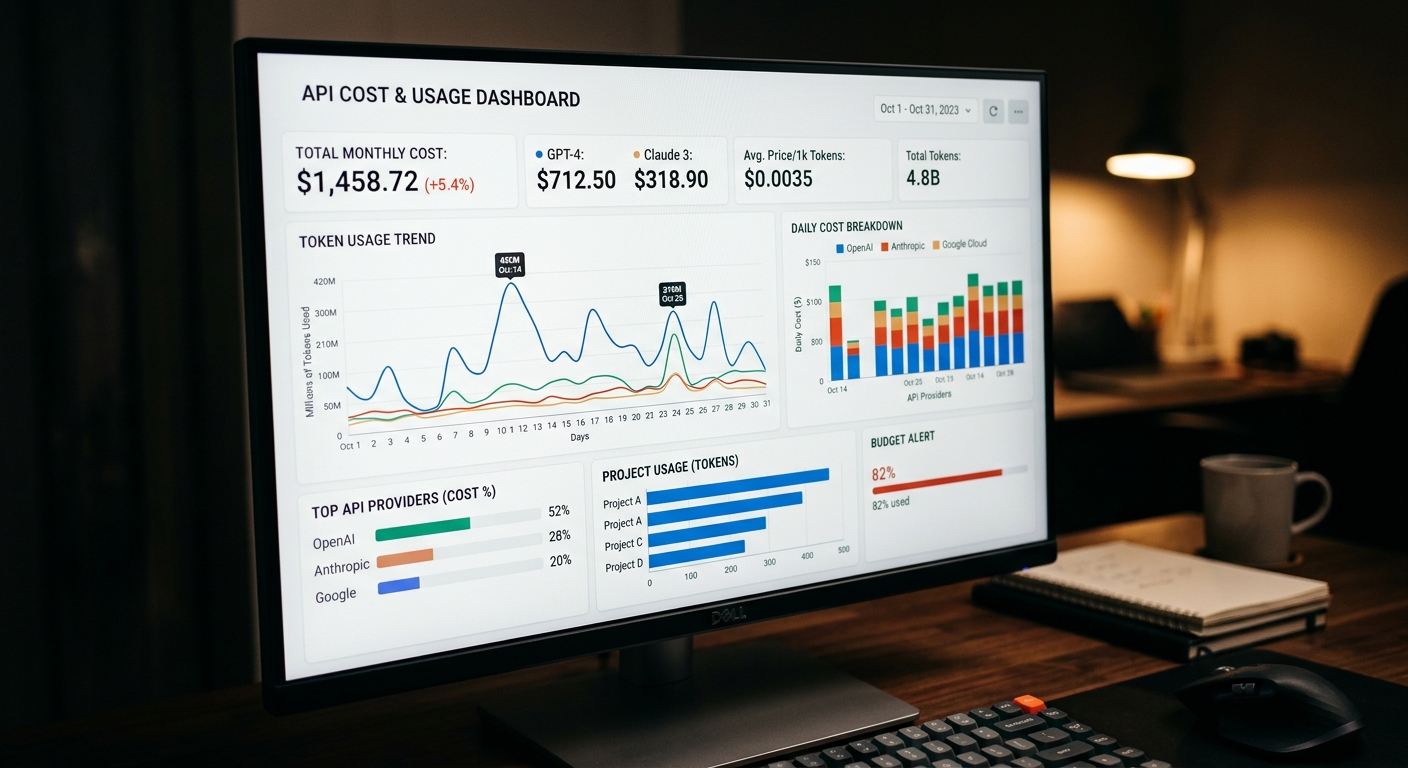
High volume production environments can eat your margins if you are not careful. We implemented a tiering system for a client where 90% of initial data processing was handled by low-cost models. Only the final 'creative' pass was sent to a high-reasoning model. This reduced their monthly API bill from $3,200 to $450 while maintaining the same output quality. You need a dashboard that monitors token usage per client so you can accurately calculate your unit economics.
2. Verification Protocols to Prevent Hallucinations
Automated client reporting is a minefield. One hallucinated number in a monthly report can destroy a year of trust. You must implement a verification layer. This is an agent whose only job is to check the output against the source data. If the numbers do not match, the workflow resets. We have experimented with this in our AI code review tools post-mortem, and the takeaway is clear. Never trust a single-pass AI output for client-facing data.

3. Transitioning to Value-Based Pricing
This is the hardest part. If you scale your agency with AI, you must kill the billable hour. Your pricing should be based on the value of the deliverable. If your automated system generates a technical audit in 10 minutes that used to take a senior engineer 10 hours, you still charge for the 10 hours of value. This is the only way to see the 'dollars' side of the equation move in your favor. If you don't make this shift, you are just passing the efficiency gains to the client and keeping the risk for yourself.
Verdict
If you want to scale, stop buying tools and start building a system. For most high-growth agencies, the winning move is to use Bolt or Lovable to build custom internal interfaces that sit on top of the Anthropic API.
This gives you full control over your IP and your margins. It allows you to integrate your proprietary data into a RAG system, ensuring your outputs are better than what a competitor can get from a generic ChatGPT prompt.
Scale is not about doing more work. It is about building a machine that does the work for you. The data is clear. Agencies that own their technical stack have a 30% higher valuation than those that rely on third-party wrappers. Stop being a customer of AI tools and start being an owner of AI assets.
One final word of caution. The legal landscape for AI generated content is shifting. The U.S. Copyright Office has been clear that works created entirely by AI without human intervention may not be eligible for copyright protection. You can find their official guidance on this here. Ensure your workflows include a 'Human-in-the-loop' stage to protect your client deliverables and your agency's liability. Check out our deep dive on writing PRDs with AI for a framework on how to handle technical verification without slowing down your production speed.