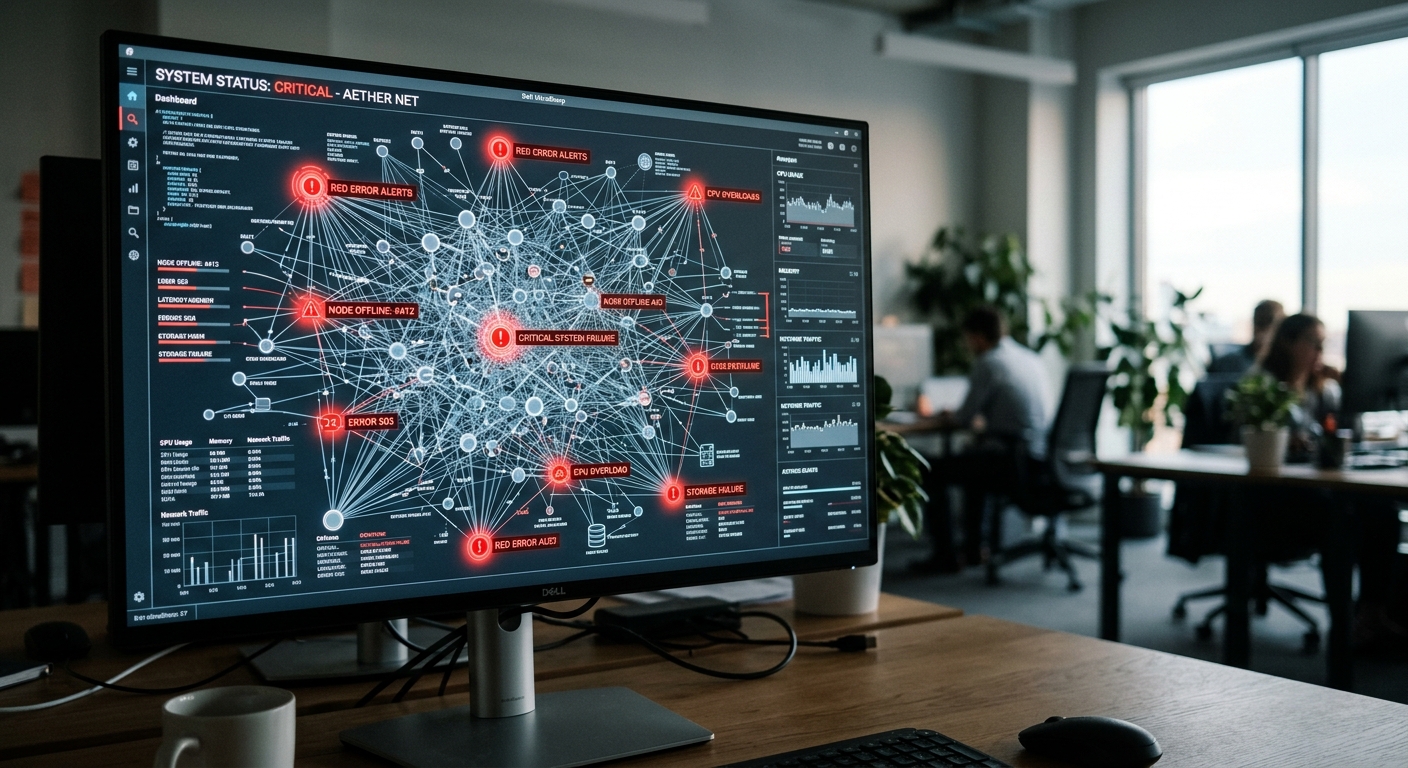
Last month, a junior engineer on my team pushed a change that triggered a cascading failure in our staging environment. It was a classic mistake. A misconfigured connection pool caused a pileup of requests, which led to massive backpressure. Our expensive AIOps tool, the one the CTO bought to 'reduce alert fatigue', did exactly what it was supposed to do. It started auto-remediating. It decided the best course of action was to restart the primary database node. Then it did it again. And again. By the time I jumped in, the tool had trapped us in a reboot loop that made it impossible to actually debug the root cause. This is the reality of the AI ops tools comparison that marketers won't tell you. Most of these tools are just fancy wrappers around statistical anomalies that fail the moment things get non-linear.
What it is
AIOps is a broad term that covers everything from simple log clustering to LLM-driven incident response. At its core, it is the application of machine learning to DevOps telemetry data. We are talking about logs, metrics, traces, and events. The goal is to move from reactive monitoring to proactive observability.
In the current market, we see two distinct flavors. First, there are the legacy observability giants that have bolted on 'AI' features to justify their seat price. These usually focus on 'noise reduction' or 'anomaly detection'. Second, there are the new incumbents using fast inference engines like Groq to provide real-time analysis of streaming telemetry. Groq is notable here because its LPU architecture allows for incredibly low latency. When you are trying to analyze 10,000 logs per second, you cannot afford to wait for a high-latency API call. Speed is the only metric that matters during an incident.
You also have niche tools that handle operations for specific verticals. Selzee, for example, functions as an AI ecommerce manager. It is not trying to fix a Kubernetes cluster. Instead, it monitors Shopify health, inventory, and ad spend. It is AIOps for the business side. It sends Slack alerts when your site health dips or inventory hits a threshold. It is a more targeted, deterministic use of AI than the 'general purpose' incident solvers that usually break in production.
What works
If you ignore the marketing fluff, there are three areas where AI actually helps an engineering team ship faster and maintain higher availability.
-
Log Clustering. Manual log analysis is a waste of human life. Tools that group 5,000 identical error messages into a single 'issue' are genuinely useful. This prevents the 'thundering herd' of alerts from drowning out the actual problem. It is not magic, it is just pattern matching, but it works.
-
Documentation and Context. This is where Fireflies.ai shines. During a high-pressure incident, nobody wants to be the dedicated scribe. Fireflies records the war room call, transcribes it, and summarizes the decisions made. This makes the post-mortem significantly easier. Instead of trying to remember why we decided against a rollback at 4 AM, we have a searchable record. It turns messy human conversation into structured data.
-
Fast Inference for Real-time Analysis. Using an API like Groq allows us to run local models that scan for PII or security regressions in real-time without adding 500ms of latency to our CI/CD pipeline.
Here is a simple example of how you might use a fast inference API to check a log stream for known regression patterns without slowing down the pipeline:
import groq

client = groq.Client(api_key='your_key')

def check_log_for_regression(log_line):
 # We need sub-10ms response times for this to be viable in a hot path
 completion = client.chat.completions.create(
 model='llama3-70b-8192',
 messages=[{'role': 'user', 'content': f'Is this log a known database regression?: {log_line}'}]
 )
 return completion.choices[0].message.content

# Example usage in a stream processor
log_entry = 'ERROR: Connection pool exhausted at 10.0.5.4'
if 'ERROR' in log_entry:
 print(check_log_for_regression(log_entry))
What does not
The biggest failure point in the AI ops tools comparison is 'auto-remediation'. Giving an AI the keys to your production environment is usually a mistake. LLMs are non-deterministic. If you give the same error log to a model five times, you might get three different 'fixes'. In a production environment, we value idempotency and predictability. A flaky remediation script is worse than no script at all.
Another major issue is the 'black box' problem. If an AI tool tells me there is a 70% chance that a specific microservice is the root cause, but it cannot show me the traces that led to that conclusion, I am going to ignore it. Engineering is about evidence, not probability. Most AIOps tools fail to provide the 'why' behind their alerts.
We also have to talk about the cost. Ingesting every single log and trace into a proprietary AI model is expensive. Many teams find that the 'observability tax' starts to eat up a significant portion of their cloud budget. You have to ask if the marginal utility of a 'smart' alert is worth the 30% increase in your Datadog bill. Often, a well-configured Prometheus alert is more reliable and costs almost nothing.

The unsaid tradeoff
The tradeoff no one mentions is the maintenance of the AI itself. You are essentially adding a new, complex dependency to your stack that requires its own monitoring and its own post-mortem process when it fails.
When you implement a tool like an Automated Incident Response with AI, you are not just 'setting and forgetting' it. You have to manage the feature flags that control which services the AI can touch. You have to monitor for model drift. You have to ensure the AI isn't hallucinating regressions where none exist.
You are trading human labor (manual monitoring) for a different kind of human labor (AI orchestration). For a large-scale enterprise, this might make sense. For a team of twenty engineers, you are just adding overhead. You also risk 'alert blindness' where the team stops trusting the AI because it has too many false positives. Once trust is gone, the tool is shelfware.
| Feature | Legacy Monitoring | AIOps Tools | AI Ecommerce (Selzee) |
|---|---|---|---|
| Logic Type | Deterministic (Regex) | Probabilistic (ML) | Business Logic + LLM |
| Setup Time | High (Manual config) | Medium (Auto-discovery) | Low (SaaS Integration) |
| Reliability | High | Variable (Flaky) | High (Specific scope) |
| Primary Use | Uptime | Root Cause Analysis | Sales & Site Health |
Who should use it
If you are managing a fleet of thousands of microservices, you probably need some form of AIOps just to keep your head above water. You cannot manually write alerts for every possible failure mode in a system that complex. In that case, look for tools that prioritize observability and log clustering over 'auto-remediation'.
If you are a smaller shop, stick to the basics. Use Fireflies.ai to make your meetings productive. Use Selzee if you are running a Shopify store and need a 24/7 eye on your inventory and site health without hiring a full-time ops person. These tools solve specific, boring problems. That is where the real value is.
Do not buy into the hype that AI will replace your on-call rotation. It won't. It will just change the nature of the incidents you deal with. You will still be there at 3 AM, but instead of fixing a database lock, you will be trying to figure out why your 'smart' monitor decided to rollback a perfectly healthy deployment.
For more on how to manage the human side of this, check out our guide on AI for User Research Synthesis. It covers how to turn messy data into actual insight, which is a much safer use case for AI than letting it touch your production database. If you are worried about the cost of all this automation, read about charging for AI assisted work to see how to balance the billable hours vs the efficiency gains.