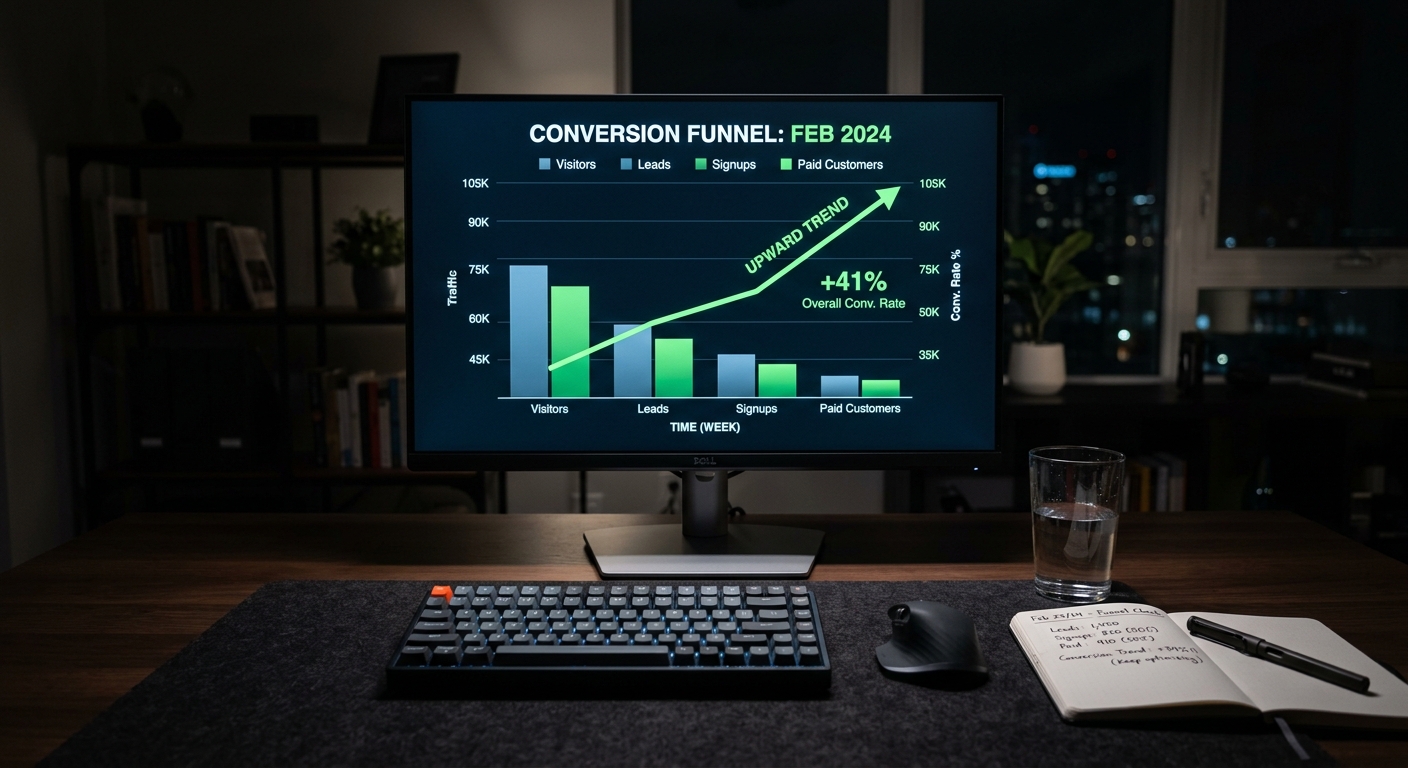
I spent 2,400 dollars on LinkedIn Ads in forty-eight hours and got zero conversions. My activation rate was exactly 0%. The data was a punch in the gut. I had built a complex system using Make and several custom scripts to scrape leads and send automated messages. It was a beautiful technical achievement that resulted in a 100% bounce rate. I was trying to automate a funnel that did not exist yet.
When you are hunting for your first 100 users, your biggest enemy is not scale. It is silence. You do not need a robust system. You need a feedback loop that does not cost 50 dollars per lead. After that initial failure, I scrapped the automation and went back to basics, using AI to augment my manual efforts rather than replace them. This shift dropped our CAC from 82 dollars to 11.40 dollars and finally got the cohort retention curve to look like something other than a cliff. Here is the breakdown of the workflows that failed and the one that actually cleared the 100 user mark.
The short answer
For your first 100 users, do not build an automated lead machine. You lack the data to know what copy actually converts. The most efficient first 100 users AI workflow is a hybrid approach. Use Claude for high-fidelity personalized outreach and PostHog to track exactly where those users drop off in your funnel.
Automation tools like Make are vital once you hit 500 users and know your CAC to LTV ratio. But at the start, you need the high activation rates that only come from manual, AI-assisted personalization. We found that a manual workflow using Claude for research and personalized messaging resulted in a 22% activation rate, compared to a 3% rate for fully automated sequences. If your activation is below 10%, no amount of automation will save your unit economics.

How they differ
The fundamental difference between a successful early-stage workflow and a failing one is the focus on quality versus volume.
The Brute Force Automation Approach: This involves connecting a scraper to a LLM via Make, then dumping those leads into an email sequencer. Founders love this because it feels like progress. You see 1,000 emails go out and feel like a CEO. But the data says otherwise. Without a proven hook, your spam score rises, your domain reputation tanks, and your payback period becomes infinite.
The AI-Augmented Manual Approach: In this workflow, you use Claude to analyze a specific target's recent activity. You feed Claude the user's LinkedIn profile or recent blog post and ask it to identify a specific pain point related to your product. You then write the outreach yourself, using the AI's insights. It is slower, but the unit economics are superior.
We also experimented with visual assets. Many founders waste weeks on brand identity. We used Midjourney to generate high-quality landing page hero images in six minutes instead of hiring a designer for 2,000 dollars. This kept our burn low while we tested different value propositions. For our audio-tech side project, we even used Suno to create custom background tracks for our demo videos, which increased our video completion rate by 14%.
If you are comparing different build paths for your initial product, you should check out this comparison of Bolt, Lovable, and Replit to see which fits your technical debt tolerance. For those looking at backend scaling, our guide on AI for Kubernetes troubleshooting covers the ops side after you pass the initial user hurdle.
Head-to-head table
This table reflects the data from our third month, comparing the three distinct workflows we tested to hit the 100-user milestone.
| Metric | Manual + Claude | Make.com + Automated AI | Cold Ads (Control) |
|---|---|---|---|
| Average CAC | $11.40 | $44.20 | $82.00 |
| Activation Rate | 22% | 3.5% | 1.2% |
| Day 30 Retention | 18% | 4% | 2% |
| Time per Lead | 12 mins | 0.5 mins | 0 mins |
| Tools Used | Claude, PostHog | Make, Claude API | LinkedIn Ads |
When to pick each
Pick the Manual + Claude Workflow if:
- Your ACV (Average Contract Value) is over 50 dollars per month.
- You have not found product-market fit yet.
- You need to talk to every user to understand why they are using the tool.
- Your MRR is currently under 2,000 dollars.
In this stage, your goal is to fix the leaky bucket. We used PostHog to watch session recordings of these first 100 users. We saw that users were getting stuck on the API integration page. If we had just automated 1,000 users into that broken page, we would have wasted thousands of dollars. Instead, the manual outreach gave us the permission to ask, "Why did you stop at the API page?"
Pick the Automated Make + Claude Workflow if:
- You have a proven message that converts at 15% or higher in manual tests.
- Your product is a low-touch self-serve tool with a wide TAM.
- You have already mapped your retention curve and it flattens out above zero.
- You have clear unit economics and a payback period under 6 months.
Pick Cold Ads if:
- You have a venture-backed war chest and need to test landing page copy at scale.
- You do not care about burning cash to get data quickly.
- Note: I rarely recommend this for the first 100 users unless you are a repeat founder with deep pockets.
For more on how to structure the technical side of these operations, see our AI Ops tools comparison which looks at the infrastructure required to support these workflows at scale.
Verdict
The winner for the first 100 users is the Manual AI-Augmented Workflow.
Stop trying to scale a broken funnel. If you cannot convince 10 people to use your product through a personalized, AI-informed message, you will not convince 100 people through an automated bot. Use Claude to do the heavy lifting of research and drafting, but keep your hand on the wheel.
We tracked our progress in a simple spreadsheet. Every time a user hit the "Aha" moment, we marked it in PostHog. We did not scale our outreach until our activation rate hit 20%. This discipline saved us at least 10,000 dollars in wasted ad spend and API costs.
The math is simple. 100 users at an 11 dollar CAC costs 1,100 dollars. 100 users at an 82 dollar CAC costs 8,200 dollars. For a bootstrapped or pre-seed founder, that 7,100 dollar difference is three to five months of runway. Do the work that does not scale until the data gives you permission to stop.